
Worldwide, most schools act as if education is a matter of filling an empty bucket. They ignore that children yearn to learn, and have brains wired to do so. Instead of building on those natural instincts, they teach for the test, and churn out graduates at all levels who have a certificate of completion but who have learned little or nothing of value, who believe that learning is always a chore because that is their only experience of it, and who lack the life skills to solve a problem unless they've already memorized an answer that someone else provided.
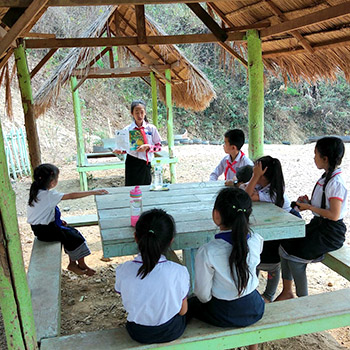


Why do nearly all of our students read by the end of grade one, some by the end of kindergarten, far ahead of their peers in public schools? It's not because we drill them endlessly and pass out a lot of worksheets – although used well, both of those have a limited role.
Humans learn to talk through a natural process. We have an instinct for it. Reading is not instinctive; you must learn some dull stuff before you get the rewards. We've kept that in mind while planning our approach. We read stories aloud so children know there's something good in those books. They become eager to read. Then they learn quickly.
We created Big Brother Mouse in 2006. Our goal then was to "Make Literacy Fun." For ten years, we worked to get books to children and schools in the countryside.
But we ran into an obstacle: Reading skills in Laos were weak when we started, and they were getting worse. A 2019 study by Unicef and the Ministry of Education found that only half of fifth-graders (typically age 10) in Laos could read simple Lao text. Today, the number is even lower.
We opened our first school, Big Sister Mouse, in 2016. It had just 13 students in grades 1 and 2, and they all learned to read.
We now have 12 schools in northern Laos, with 4200 students. They learn not just reading but also math and geography. They learn not just school subjects but also life skills: Problem-solving, cooperation, taking initiative, handling responsibility, and critical thinking. And, a factor often overlooked by school administrators worldwide but every bit as important: They're happy.
One element of our approach was difficult to get started, because it went against long-ingrained assumptions. But we believe it's a big part of our success. Children who understand a subject, help others to learn it.


Some of our schools, named Big Sister Mouse, are run by Big Brother Mouse. Others were created by members of our staff who moved away to make a difference in other regions, usually near their hometowns. Here's more about each.
Big Sister Mouse: We operate three schools: Two on the outskirts of Luang Prabang city, one in Xieng Ngen district.
Ton Kit: Siphone, who was a key part of Big Brother Mouse from the beginning, was so disturbed at the poor quality of schooling in his home area that he moved back and built Ton Kit school. It quickly filled – it now has nearly 800 students – so he built another, and is working on a third.
Little Rabbit: Like Siphone, Phon, who also worked with us, found that schools in his hometown in Udom Xai province had greatly deteriorated, so he too moved back and did something about it.
Little Elephant: Keo worked with us for many years, then moved to his home region in Bokeo province in the north of Laos. He has opened a preschool and is adding a primary school.
Little Bear: Kongsy was a director at our first Big Sister Mouse school. He moved to Nan district, on the road to Xayabuli, so that children there could also have better opportunities.
Although run independently, all of our schools work together closely, sharing ideas and discussing problems, often visiting one another. That is a great source of strength.
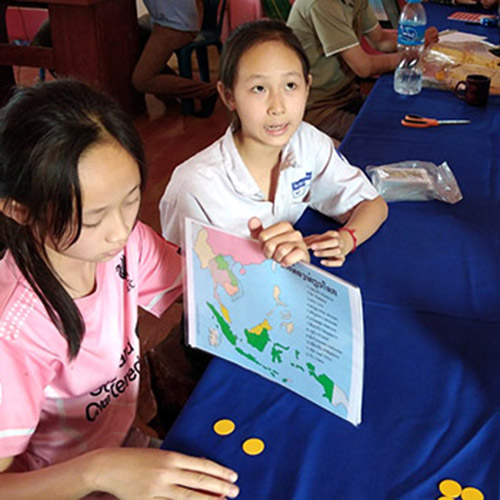

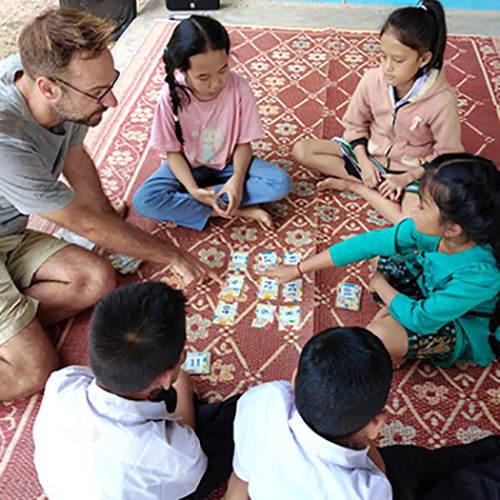
Games offer an enjoyable way for students to improve skills and knowledge in many subjects. They also offer a less recognized benefit: Games involve making decisions. Students in rote-based classrooms get little experience with this, and many reach adulthood intimidated by even the simple decisions that life throws at them. A few games are briefly described here. You'll find more on our activities page.

With all the activities and games our schools offer, observers sometimes ask, "Do students also learn reading, math, and so on?"
Absolutely. Learning to read is mostly about motivation. Knowing that books have fun stories in them, seeing your peers and parents reading, and being surrounded by books, all help. For a motivated child it takes some time to learn to read, but not a lot. If it's not happening, more hours of reciting the alphabet is not going to fix things.
Walk into one of our first-grade classrooms mid-year and you may find students absorbed in our book The Crow Looks For the Horse. By most definitions, it is the worst children's book ever published. It has no pictures, no characters, no storyline, no color. It's got only one thing going for it: It works.
This book contains lists of rhyming words. There's a "headword" in bold type, and under that are words that rhyme – only the first letter is different. (The book's odd title, in Lao, is 'Gaa Maa Haa Maa.')
For as long as they've been in our school, kids have heard stories read aloud. They know there's something good in those books. They'd like to get at it themselves... just like a grown-up!
In kindergarten they learn the alphabet. Then, after they've read the headword (which may require some help at first), they just need to change the opening sound, and they can read each new word below it. They can say to themselves, 'I'm reading!'

Lao is phonetic, so short words that rhyme are always spelled the same except for the opening consonant. We've got none of the confusion caused by English words such as toe though tough through to two ....
By the end of first grade, some of our students are reading Lao folktales, with a paragraph (and picture) on each page. Others read our 200-page Lao adaptation of The Wind in the Willows.