
Twice every day, 7 days a week, we invite visitors and Lao people to meet and interact at our shop in Luang Prabang. For many years, the focus was English conversation. Participants could learn about one another's countries and cultures, while Lao youth improved their English skills.
But over the years, we've noticed a troubling trend: An increasing number of Lao youth want only to learn English. They consider it waste of time to learn or do anything else. And largely, they see English proficiency as a ticket to leave the country.


When we began the conversation sessions, most Lao young people learned English so they could get a local job as a guide or waiter. Now, "I want to get a scholarship abroad" is the usual stated goal, although if English is the only thing they've learned, scholarships are unlikely. "Meet a partner for marriage or romance, who will take me abroad" is never a stated goal but is clearly a factor in some cases.
This English-only focus is reinforced by visitors who offer assurances like "English is your key to success." It's understandable that they wish to believe that what they can enjoyably provide is the critical need. And Lao youth tend to believe them; after all, this was said by someone from a successful (well, richer, in any case) country; the person saying it surely knows how to be successful! An echo chamber develops. Group-think takes over.
But it's wrong. English in itself is not the key to success. English is a valuable skill, but if it's your only skill, it'll get you a job as a waiter, and not much else.
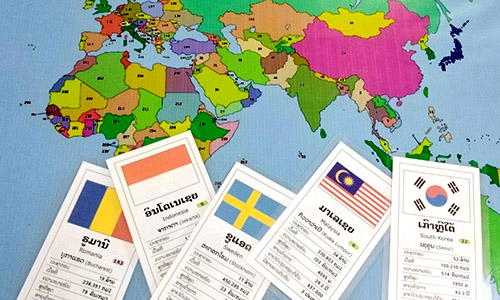
This narrow focus, coupled with weak, rote-based public schools, meant that young people coming to our sessions learned to banter comfortably in English, but many had learned little else. They could not find Europe on a map. They did not know how much is 6x4. They did not know in what century World War II took place. These weren't outliers; we frequently saw all of these gaps among regulars at our English sessions.
Far worse, many were not developing essential life skills: Problem-solving, planning ahead, critical thinking, self-control, creativity, leadership, initiative, and much else.
Laos badly needs people with these skills. We need them to start and run Lao-owned businesses. We need them in education, government, health care, and everywhere else.
It is also essential for their own sake that individuals develop critical-thinking skills. Many traps await young people, especially in poorer countries, who are too ready to believe whatever they are told. We've known Lao people who became enmeshed in a Ponzi scheme (outcome: heavy borrowing, couldn't repay, went to prison, marriage fell apart); reckless gambling (outcome: divorce, had to liquidate a good business); and mega cyberscam operations (they become the victim exploited for labor, to find other victims exploited for money).
Our primary focus is our schools and books; we can't do everything. But we decided to use our limited space and time to promote a wider range of skills and knowledge. In May of 2026, we shifted the focus of our visitor sessions to include a variety of activities and games. Visitors remain a welcome and important part of these sessions. You'll take part in games and activities that we've developed at our schools. It's enjoyable, and at the end, you'll probably say, "I learned, too!"

Low-income young people here frequently fall victim to cyberscam operations in Southeast Asia. We know a young man with good English skills who was lured into a large-scale operation across the border. His job was to pretend to be a young woman as he fished around online to find gullible, lonely men who wanted – well, what do you think they wanted? – at which point a genuine young woman took over, turned on the video camera, and tried to reel in the prey. There was a relatively happy outcome in this particular case: He did such a poor job that the operator kicked him out.
Others are not so lucky. In February 2026 the U.N. Human Rights office reported on these operations in A Wicked Problem, with an estimate that 300,000 people are held in giant cyberscam compounds, heavily based in Southeast Asia.
Young males with good English ability but weak critical-thinking skills are the prime recruits. Most come from poorer countries in Southeast Asia and Africa. Commonly, they are lured to the scam center with bogus promises, and are given a loan with which to pay a recruitment fee or transportation costs. On arrival, their passports are taken ("to get you a visa") and they are locked into a large compound with limited or no outside communication. They must then work until the loan, along with room-and-board charges which they cannot control, is paid off. In short, they become slaves, under a thin veneer of legality.
Most cyberscam exposes focus on people in weathier countries who lose money to frauds. This is cyberscam's other victims. Their's is a modern horror story that goes largely unnoticed. David Whitehouse, in his "Dark Side of Development" column on SubStack, gives regular attention to this and other ways that the unsuspecting are exploited, such as abusive micro-finance operations.